Vermont Court Order — Stalking Complaint Denied
Melanie MacEachern v. Kurtis Mellett • Vermont Superior Court • May 27, 2026
On May 27, 2026, the Vermont Superior Court denied the complaint for an order against stalking against Kurtis Mellett.
In its Order on Remand, the Court found Kurtis Mellett’s testimony credible. The Court concluded that he did not intend to closely watch or carefully observe the plaintiff, did not track or collect information about her, did not engage in monitoring, and had not otherwise followed or threatened her.
The Court concluded that Kurtis Mellett had not engaged in the requisite “course of conduct” that could support relief under Vermont’s civil stalking statute. The complaint was DENIED.
The complete text of the official May 27, 2026 Vermont Superior Court Order on Remand is reproduced below.
Official Vermont Superior Court Order on Remand
VERMONT SUPERIOR COURT
Orleans Unit
247 Main Street
Newport VT 05855
802-334-3305
www.vermontjudiciary.org
CIVIL DIVISION
Case No. 25-ST-01200
Melanie MacEachern v. Kurtis Mellett
ORDER ON REMAND
Plaintiff Melanie MacEachern filed a complaint for an order against stalking against defendant Kurtis Mellett in this case, and filed a separate complaint for an order against stalking against defendant’s wife Margot Mellett in Case No. 25-ST-1202. The cases were consolidated for hearing before the undersigned at the end of the day on November 13, 2025, along with a status conference in the parties’ related civil action in Case No. 24-CV-1685.
After evidence was taken on the stalking complaints, the court denied both complaints on the record before conducting the civil status conference. Plaintiff then appealed the denial of the complaint against defendant but did not appeal the denial of the complaint against Margo Mellett, which has become final. On appeal, a three-judge panel of the Vermont Supreme Court reversed the denial of the complaint against defendant and remanded “for additional findings on the elements of stalking.” See 25-AP-439. The court appreciates the opportunity to clarify its findings, which were made at the end of the day in the midst of a consolidated hearing with multiple issues to address, and were admittedly “very sparse.” See id.
In its decision on appeal, the panel explained that demonstrating “surveillance” under the civil stalking statute “requires showing an intent to closely watch or carefully observe a person or place,” and “[m]erely passing by someone’s property and looking around is insufficient to demonstrate such intent.” Id. (quotations and alterations omitted). The court further explained that “[m]onitoring involves tracking or collecting some form of information about the person being monitored or their activities.” Id.
In this case, what the court inartfully tried to express at the conclusion of the November 13 hearing was that it found defendant’s testimony credible. Specifically, the court credits defendant’s testimony that he had legitimate reasons to pass by plaintiff’s property, that he had been walking on the road next to plaintiff’s property his whole life, and that he would merely glance over at plaintiff’s property when he was passing by. The court concludes based on defendant’s credible testimony that defendant did not intend to closely watch or carefully observe plaintiff, and that defendant did not track or collect information about plaintiff.
Because the court credits defendant’s testimony that he lacked the requisite intent to surveil, and did not engage in monitoring, and that defendant has not otherwise followed or threatened plaintiff, the court concludes that defendant has not engaged in the requisite “course of conduct” that could support relief under the civil stalking statue.
The court regrets stating that “[i]t seems like both sides are watching each other’s every moves and watching each other with a significant amount of anxiety.” This statement was intended as a comment on the parties’ contentious litigation history in the related civil action—with which the court is very familiar and which was also set for a status conference on the afternoon of November 13—and not as a factual finding based on the evidence presented in the stalking hearing.
Based on the findings and conclusions made on the record at the November 13 hearing, and the additional findings and conclusions set forth above, plaintiff’s complaint for an order against stalking is DENIED.
Electronically signed on: 5/27/2026 pursuant to V.R.E.F. 9(d)
Benjamin D. Battles
Superior Court Judge
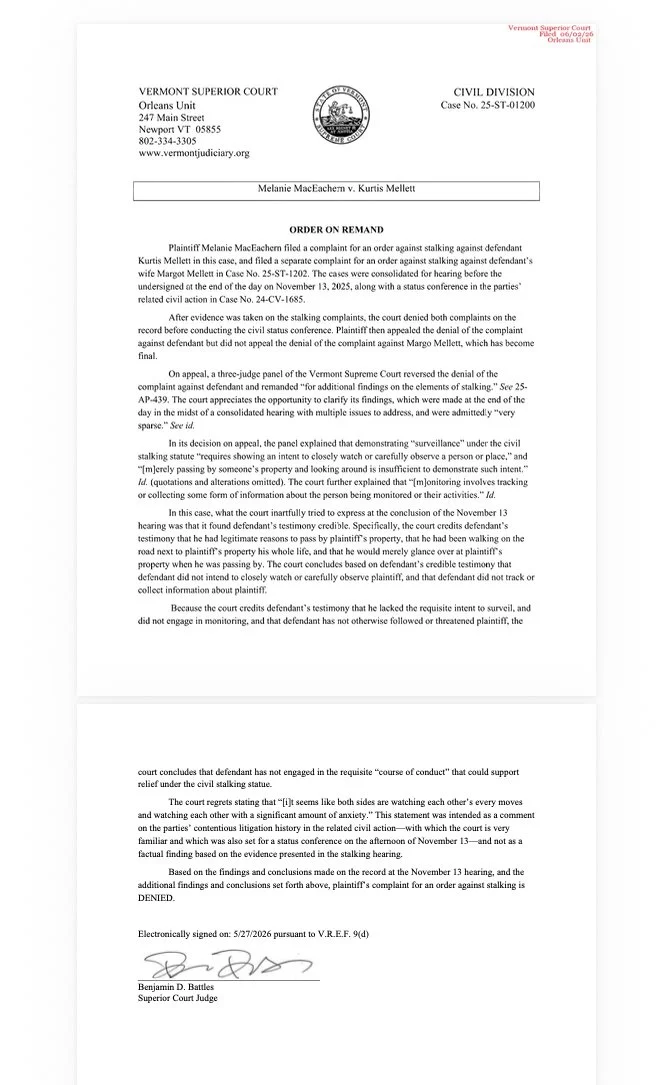
Vermont Superior Court Order on Remand in Melanie MacEachern v. Kurtis Mellett, May 27, 2026